Debye-Waller factor
The Debye-Waller factor is a term (in scattering equations) which accounts for how thermal fluctuations extinguish scattering intensity (especially high-q peaks). This scattering intensity then appears as diffuse scattering. Conceptually, thermal fluctuations create disorder, because the atoms/particles oscillate about their equilibrium positions and thus the lattice is never (instantaneously) perfect.
Mathematical form
For a lattice-size a, the constituent entities (atoms, particles, etc.) will oscillate about their equilibrium positions with an rms width , attenuating structural peaks like:

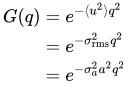
Where Failed to parse (MathML with SVG or PNG fallback (recommended for modern browsers and accessibility tools): Invalid response ("Math extension cannot connect to Restbase.") from server "https://wikimedia.org/api/rest_v1/":): {\displaystyle \sigma_{\mathrm{rms}} \equiv \sqrt{ \langle u^2 \rangle }} is the root-mean-square displacement of the lattice-spacing a (such that the spacing at time t is Failed to parse (MathML with SVG or PNG fallback (recommended for modern browsers and accessibility tools): Invalid response ("Math extension cannot connect to Restbase.") from server "https://wikimedia.org/api/rest_v1/":): {\displaystyle a+u(t)} ), and Failed to parse (MathML with SVG or PNG fallback (recommended for modern browsers and accessibility tools): Invalid response ("Math extension cannot connect to Restbase.") from server "https://wikimedia.org/api/rest_v1/":): {\displaystyle \sigma_a \equiv \sigma_{\mathrm{rms}}/a} is the relative displacement.

