Quantum Mechanics
Quantum mechanics is a theory that describes the interactions of all particles and systems. It underlies all physical phenomena, including scattering.
Contents
Wavefunction
A quantum system is completely specified by its Wave Function:
| Integral Notation | Dirac Notation |
|---|---|
| Failed to parse (MathML with SVG or PNG fallback (recommended for modern browsers and accessibility tools): Invalid response ("Math extension cannot connect to Restbase.") from server "https://wikimedia.org/api/rest_v1/":): {\displaystyle \psi(x) } |

The wavefunction is typically normalized:
| Integral Notation | Dirac Notation |
|---|---|
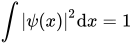

The distribution of the particle described by is given by:

| Integral Notation | Dirac Notation |
|---|---|


In the Copenhagen Interpretation, is the probability of finding the particle at location . In Universal Wave Function interpretations (e.g. MWI), can be thought of as the spatial distribution of the particle. The wavefunction contains all the information one can know about a system. It can thus be thought of as 'being' the particle/system in question. However, the wavefunction can be described in an infinite number of different ways. That is, there is not a unique basis for describing the wavefunction. So, for instance, one can describe the wavefunction using position-space or momentum-space:


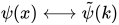
These representations can be inter-related (c.f. Fourier transform):
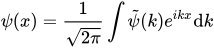
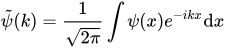
State
Note that the wavefunction describes the state of the system; there are various choices of basis one can use as an expansion.
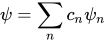
This can also be viewed as a vector in the Hilbert space. The Dirac notation (bra-ket notation) is useful in this regard. A particular state is a (column) vector:
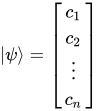
Which is a 'ket'. We define a 'bra' (the 'final state') as a (row) vector:

And note that the 'bra' is the conjuagte transpose of the 'ket':

Wave packet
TBD
Heisenberg Indeterminacy Relations
(Also known as Heisenberg Uncertainty Principle.)


Superposition
If and Failed to parse (MathML with SVG or PNG fallback (recommended for modern browsers and accessibility tools): Invalid response ("Math extension cannot connect to Restbase.") from server "https://wikimedia.org/api/rest_v1/":): {\displaystyle \psi_2(x)} are both allowed states for a given system, then the following state is also allowed:


This leads to a notable consequence:

Notice that the final terms represent 'interference' between the two constituent states. This interference has no classical analogue; it is a quantum effect. Thus a superposition is not merely a 'joining' of the two states (e.g. "the particle can be in state 1 or state 2"), but a truly coherent interference between the two states. The superposition may be more generally written as:
| Integral Notation | Dirac Notation |
|---|---|
| Failed to parse (MathML with SVG or PNG fallback (recommended for modern browsers and accessibility tools): Invalid response ("Math extension cannot connect to Restbase.") from server "https://wikimedia.org/api/rest_v1/":): {\displaystyle \int | \psi(x) |^2 \mathrm{d}x = 1} | Failed to parse (MathML with SVG or PNG fallback (recommended for modern browsers and accessibility tools): Invalid response ("Math extension cannot connect to Restbase.") from server "https://wikimedia.org/api/rest_v1/":): {\displaystyle \langle \psi | \psi \rangle = 1} |
The distribution of the particle described by Failed to parse (MathML with SVG or PNG fallback (recommended for modern browsers and accessibility tools): Invalid response ("Math extension cannot connect to Restbase.") from server "https://wikimedia.org/api/rest_v1/":): {\displaystyle \psi(x)} is given by:
| Integral Notation | Dirac Notation |
|---|---|
| Failed to parse (MathML with SVG or PNG fallback (recommended for modern browsers and accessibility tools): Invalid response ("Math extension cannot connect to Restbase.") from server "https://wikimedia.org/api/rest_v1/":): {\displaystyle \psi(x) = \sum_n c_n \psi_n } | Failed to parse (MathML with SVG or PNG fallback (recommended for modern browsers and accessibility tools): Invalid response ("Math extension cannot connect to Restbase.") from server "https://wikimedia.org/api/rest_v1/":): {\displaystyle |\psi\rangle = c_1 | 1 \rangle + c_2 | 2 \rangle + c_3 | 3 \rangle + \cdots } |
Measurement
The transition of the wavefunction Failed to parse (MathML with SVG or PNG fallback (recommended for modern browsers and accessibility tools): Invalid response ("Math extension cannot connect to Restbase.") from server "https://wikimedia.org/api/rest_v1/":): {\displaystyle \psi} into state Failed to parse (MathML with SVG or PNG fallback (recommended for modern browsers and accessibility tools): Invalid response ("Math extension cannot connect to Restbase.") from server "https://wikimedia.org/api/rest_v1/":): {\displaystyle \phi} can be thought of as:
| Failed to parse (MathML with SVG or PNG fallback (recommended for modern browsers and accessibility tools): Invalid response ("Math extension cannot connect to Restbase.") from server "https://wikimedia.org/api/rest_v1/":): {\displaystyle \int \phi^* \psi \mathrm{d}x } | Failed to parse (MathML with SVG or PNG fallback (recommended for modern browsers and accessibility tools): Invalid response ("Math extension cannot connect to Restbase.") from server "https://wikimedia.org/api/rest_v1/":): {\displaystyle \langle \phi | \psi \rangle = a_1^*c_1 + a_2^*c_2 + a_3^*c_3 + \cdots } |
The 'probability' is:
| Failed to parse (MathML with SVG or PNG fallback (recommended for modern browsers and accessibility tools): Invalid response ("Math extension cannot connect to Restbase.") from server "https://wikimedia.org/api/rest_v1/":): {\displaystyle ? } | Failed to parse (MathML with SVG or PNG fallback (recommended for modern browsers and accessibility tools): Invalid response ("Math extension cannot connect to Restbase.") from server "https://wikimedia.org/api/rest_v1/":): {\displaystyle \Pr( O_n ) = | \lang n | \psi \rang |^2 = | c_n |^2 } |

