Difference between revisions of "Talk:Scattering"
KevinYager (talk | contribs) (→TSAXS 3D) |
KevinYager (talk | contribs) (→TSAXS 3D) |
||
| Line 12: | Line 12: | ||
\end{alignat} | \end{alignat} | ||
</math> | </math> | ||
| − | where <math>\scriptstyle d</math> is the sample-detector distance, <math>\scriptstyle \alpha_f ^{\prime} </math> is the out-of-plane component (angle w.r.t. to ''y''-axis, rotation about x-axis), and <math>\scriptstyle \theta_f </math> is the in-plane component (rotation about ''z''-axis). The alternate angle, <math>\scriptstyle \alpha_f </math>, is the elevation angle in the plane defined by <math>\scriptstyle \theta_f </math>. | + | where <math>\scriptstyle d</math> is the sample-detector distance, <math>\scriptstyle \alpha_f ^{\prime} </math> is the out-of-plane component (angle w.r.t. to ''y''-axis, rotation about x-axis), and <math>\scriptstyle \theta_f </math> is the in-plane component (rotation about ''z''-axis). The alternate angle, <math>\scriptstyle \alpha_f </math>, is the elevation angle in the plane defined by <math>\scriptstyle \theta_f </math>. |
| − | + | ====Total scattering=== | |
| + | The full scattering angle is: | ||
:<math> | :<math> | ||
\begin{alignat}{2} | \begin{alignat}{2} | ||
| Line 43: | Line 44: | ||
q & = \frac{4 \pi}{\lambda} \sin \left( \theta_s \right) \\ | q & = \frac{4 \pi}{\lambda} \sin \left( \theta_s \right) \\ | ||
& = \pm \frac{4 \pi}{\lambda} \sqrt{ \frac{1-\cos 2\theta_s }{2} } \\ | & = \pm \frac{4 \pi}{\lambda} \sqrt{ \frac{1-\cos 2\theta_s }{2} } \\ | ||
| − | & = | + | & = \frac{4 \pi}{\lambda} \sqrt{ \frac{1}{2}\left(1 - \frac{d}{\sqrt{d^2+x^2+z^2}} \right) } |
\end{alignat} | \end{alignat} | ||
</math> | </math> | ||
| + | Where we take for granted that ''q'' must be positive. | ||
| + | ====In-plane only==== | ||
| + | If <math>\scriptstyle \alpha_f = 0 </math> (and <math>\scriptstyle \alpha_f ^{\prime} = 0</math>), then <math>\scriptstyle q_z = 0 </math>, <math>\scriptstyle 2 \theta_s = \theta_f </math>, and: | ||
| + | :<math> | ||
| + | q = k \sin \theta_f | ||
| + | </math> | ||
| + | |||
| + | ====Components==== | ||
The [[momentum transfer]] components are: | The [[momentum transfer]] components are: | ||
:<math> | :<math> | ||
| Line 54: | Line 63: | ||
q_z & = \frac{2 \pi}{\lambda} \sin \alpha_f | q_z & = \frac{2 \pi}{\lambda} \sin \alpha_f | ||
\end{alignat} | \end{alignat} | ||
| − | |||
| − | |||
| − | |||
| − | |||
| − | |||
| − | |||
</math> | </math> | ||
Revision as of 11:30, 30 December 2015
TSAXS 3D
The q-vector in fact has three components:
- Failed to parse (MathML with SVG or PNG fallback (recommended for modern browsers and accessibility tools): Invalid response ("Math extension cannot connect to Restbase.") from server "https://wikimedia.org/api/rest_v1/":): {\displaystyle \mathbf{q} = \begin{bmatrix} q_x & q_y & q_z \end{bmatrix} }
Consider that the x-ray beam points along +y, so that on the detector, the horizontal is x, and the vertical is z. We assume that the x-ray beam hits the flat 2D area detector at 90° at detector (pixel) position . The scattering angles are then:

- Failed to parse (MathML with SVG or PNG fallback (recommended for modern browsers and accessibility tools): Invalid response ("Math extension cannot connect to Restbase.") from server "https://wikimedia.org/api/rest_v1/":): {\displaystyle \begin{alignat}{2} \theta_f & = \arctan\left[ \frac{x}{d} \right] \\ \alpha_f ^\prime & = \arctan\left[ \frac{z}{d} \right] \\ \alpha_f & = \arctan \left[ \frac{z }{d / \cos \theta_f} \right] \end{alignat} }
where Failed to parse (MathML with SVG or PNG fallback (recommended for modern browsers and accessibility tools): Invalid response ("Math extension cannot connect to Restbase.") from server "https://wikimedia.org/api/rest_v1/":): {\displaystyle \scriptstyle d} is the sample-detector distance, Failed to parse (MathML with SVG or PNG fallback (recommended for modern browsers and accessibility tools): Invalid response ("Math extension cannot connect to Restbase.") from server "https://wikimedia.org/api/rest_v1/":): {\displaystyle \scriptstyle \alpha_f ^{\prime} } is the out-of-plane component (angle w.r.t. to y-axis, rotation about x-axis), and is the in-plane component (rotation about z-axis). The alternate angle, , is the elevation angle in the plane defined by Failed to parse (MathML with SVG or PNG fallback (recommended for modern browsers and accessibility tools): Invalid response ("Math extension cannot connect to Restbase.") from server "https://wikimedia.org/api/rest_v1/":): {\displaystyle \scriptstyle \theta_f } .


=Total scattering
The full scattering angle is:
- Failed to parse (MathML with SVG or PNG fallback (recommended for modern browsers and accessibility tools): Invalid response ("Math extension cannot connect to Restbase.") from server "https://wikimedia.org/api/rest_v1/":): {\displaystyle \begin{alignat}{2} 2 \theta_s = \Theta & = \arctan\left[ \frac{ \sqrt{x^2 + z^2}}{d} \right] \\ & = \arctan\left[ \frac{ \sqrt{(d \tan \theta_f)^2 + (d \tan \alpha_f^\prime )^2}}{d} \right] \\ & = \arctan\left[ \sqrt{\tan^2 \theta_f + \tan^2 \alpha_f^\prime } \right] \\ & = \arctan\left[ \sqrt{\tan^2 \theta_f + \frac{ \tan^2 \alpha_f }{ \cos^2 \theta_f } } \right] \\ \end{alignat} }
The total momentum transfer is:
- Failed to parse (MathML with SVG or PNG fallback (recommended for modern browsers and accessibility tools): Invalid response ("Math extension cannot connect to Restbase.") from server "https://wikimedia.org/api/rest_v1/":): {\displaystyle \begin{alignat}{2} q & = \frac{4 \pi}{\lambda} \sin \left( \theta_s \right) \\ & = \frac{4 \pi}{\lambda} \sin \left( \frac{1}{2} \arctan\left [ \frac{\sqrt{x^2 + z^2}}{d} \right ] \right) \end{alignat} }
Given that:
- Failed to parse (MathML with SVG or PNG fallback (recommended for modern browsers and accessibility tools): Invalid response ("Math extension cannot connect to Restbase.") from server "https://wikimedia.org/api/rest_v1/":): {\displaystyle \begin{alignat}{2} \cos( \arctan[u]) & = \frac{1}{\sqrt{1+u^2}} \\ \cos( 2 \theta_s ) & = \frac{1}{\sqrt{1 + (\sqrt{x^2+z^2}/d)^2}} \\ & = \frac{d}{\sqrt{d^2+x^2+z^2}} \end{alignat} }
We can also write:
- Failed to parse (MathML with SVG or PNG fallback (recommended for modern browsers and accessibility tools): Invalid response ("Math extension cannot connect to Restbase.") from server "https://wikimedia.org/api/rest_v1/":): {\displaystyle \begin{alignat}{2} q & = \frac{4 \pi}{\lambda} \sin \left( \theta_s \right) \\ & = \pm \frac{4 \pi}{\lambda} \sqrt{ \frac{1-\cos 2\theta_s }{2} } \\ & = \frac{4 \pi}{\lambda} \sqrt{ \frac{1}{2}\left(1 - \frac{d}{\sqrt{d^2+x^2+z^2}} \right) } \end{alignat} }
Where we take for granted that q must be positive.
In-plane only
If Failed to parse (MathML with SVG or PNG fallback (recommended for modern browsers and accessibility tools): Invalid response ("Math extension cannot connect to Restbase.") from server "https://wikimedia.org/api/rest_v1/":): {\displaystyle \scriptstyle \alpha_f = 0 } (and ), then , , and:


Components
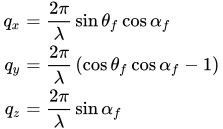
The momentum transfer components are:
Check
As a check of these results, consider:
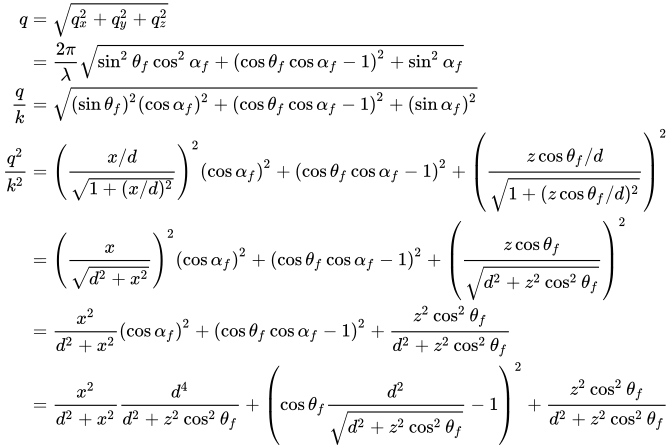
Where we used:
![{\displaystyle {\begin{alignedat}{2}\sin(\arctan[u])&={\frac {u}{\sqrt {1+u^{2}}}}\\\sin \theta _{f}&=\sin(\arctan[x/d])\\&={\frac {x/d}{\sqrt {1+(x/d)^{2}}}}\\&={\frac {x}{\sqrt {d^{2}+x^{2}}}}\end{alignedat}}}](https://wikimedia.org/api/rest_v1/media/math/render/svg/fc9628f0d308053600f4e02d8f80c69fc9f356d0)
And, we further note that:
![{\displaystyle {\begin{alignedat}{2}\cos(\arctan[u])&={\frac {1}{\sqrt {1+u^{2}}}}\\\cos \theta _{f}&={\frac {1}{\sqrt {1+(x/d)^{2}}}}\\&={\frac {d^{2}}{\sqrt {d^{2}+x^{2}}}}\end{alignedat}}}](https://wikimedia.org/api/rest_v1/media/math/render/svg/584da470743b7feac2b55988526dabce5b4313c4)
cont
Continuing:
![{\displaystyle {\begin{alignedat}{2}{\frac {q^{2}}{k^{2}}}&={\frac {x^{2}}{d^{2}+x^{2}}}{\frac {d^{4}}{d^{2}+z^{2}\cos ^{2}\theta _{f}}}+\left({\frac {d^{2}}{\sqrt {d^{2}+x^{2}}}}{\frac {d^{2}}{\sqrt {d^{2}+z^{2}\cos ^{2}\theta _{f}}}}-1\right)^{2}+{\frac {z^{2}}{d^{2}+z^{2}\cos ^{2}\theta _{f}}}{\frac {d^{4}}{d^{2}+x^{2}}}\\&=d^{4}{\frac {x^{2}+z^{2}}{(d^{2}+x^{2})(d^{2}+z^{2}\cos ^{2}\theta _{f})}}+\left({\frac {d^{4}}{\sqrt {(d^{2}+x^{2})(d^{2}+z^{2}\cos ^{2}\theta _{f})}}}-1\right)^{2}\\&={\frac {d^{4}x^{2}+d^{4}z^{2}}{d^{4}+d^{2}x^{2}+d^{4}z^{2}}}+\left({\frac {d^{4}}{\sqrt {d^{4}+d^{2}x^{2}+d^{4}z^{2}}}}-1\right)^{2}\\&={\frac {d^{2}x^{2}+d^{2}z^{2}}{d^{2}+x^{2}+d^{2}z^{2}}}+\left({\frac {d^{8}}{d^{4}+d^{2}x^{2}+d^{4}z^{2}}}-2{\frac {d^{4}}{\sqrt {d^{4}+d^{2}x^{2}+d^{4}z^{2}}}}+1\right)\\&={\frac {d^{2}x^{2}+d^{2}z^{2}}{d^{2}+x^{2}+d^{2}z^{2}}}+{\frac {d^{6}}{d^{2}+x^{2}+d^{2}z^{2}}}-2{\frac {d^{3}}{\sqrt {d^{2}+x^{2}+d^{2}z^{2}}}}+1\\&={\frac {d^{2}x^{2}+d^{2}z^{2}+d^{6}-2d^{3}{\sqrt {d^{2}+x^{2}+d^{2}z^{2}}}+d^{2}+x^{2}+d^{2}z^{2}}{d^{2}+x^{2}+d^{2}z^{2}}}\\&={\frac {d^{6}+d^{2}+d^{2}x^{2}+x^{2}+2d^{2}z^{2}-2d^{3}{\sqrt {d^{2}+x^{2}+d^{2}z^{2}}}}{d^{2}+x^{2}+d^{2}z^{2}}}\\&={\frac {(x^{2}+z^{2})}{(d^{2}+x^{2}+z^{2})}}{\frac {(d^{2}+x^{2}+z^{2})}{(x^{2}+z^{2})}}{\frac {d^{6}+d^{2}(1+x^{2}+2z^{2})+x^{2}-2d^{3}{\sqrt {d^{2}(1+z^{2})+x^{2}}}}{d^{2}(1+z^{2})+x^{2}}}\\&=?\\&={\frac {x^{2}+z^{2}}{d^{2}+x^{2}+z^{2}}}\\{\frac {q}{k}}&={\sqrt {\frac {x^{2}+z^{2}}{d^{2}+x^{2}+z^{2}}}}\\&={\frac {\sqrt {x^{2}+z^{2}}}{\sqrt {d^{2}+x^{2}+z^{2}}}}\\&={\frac {\left[{\sqrt {x^{2}+z^{2}}}/d\right]}{\sqrt {1+\left[{\sqrt {x^{2}+z^{2}}}/d\right]^{2}}}}\\&=\sin \left(\arctan \left[{\frac {\sqrt {x^{2}+z^{2}}}{d}}\right]\right)\\q&={\frac {2\pi }{\lambda }}\sin \left(2\theta _{s}\right)\end{alignedat}}}](https://wikimedia.org/api/rest_v1/media/math/render/svg/1ec9f3c8b23c8d667e098945bc49229940656e47)

