Difference between revisions of "Origin of neutron scattering lengths"
KevinYager (talk | contribs) (→Neutron energy) |
KevinYager (talk | contribs) |
||
| Line 61: | Line 61: | ||
\end{alignat} | \end{alignat} | ||
</math> | </math> | ||
| − | This final equation gives a first-order estimate for the scattering length, ''b'', given the radius of the nucleus (R ~ 10<sup>−15</sup> m) and the depth of the potential well (''V''<sub>0</sub> ~ MeV). | + | This final equation gives a first-order estimate for the [[Neutron scattering lengths|scattering length]], ''b'', given the radius of the nucleus (R ~ 10<sup>−15</sup> m) and the depth of the potential well (''V''<sub>0</sub> ~ MeV). |
[[Image:Neutron b tan02.png|500px]] | [[Image:Neutron b tan02.png|500px]] | ||
The extreme variation of ''b/R'' as a function of ''qR'' means that with each nucleon added, the scattering length jumps to a very different value. This also demonstrates why the scattering length can be negative (indicative of negative phase shift). This model should only be taken qualitatively, of course (e.g. we have neglected absorption, as well as the detailed form of the nuclear potential). | The extreme variation of ''b/R'' as a function of ''qR'' means that with each nucleon added, the scattering length jumps to a very different value. This also demonstrates why the scattering length can be negative (indicative of negative phase shift). This model should only be taken qualitatively, of course (e.g. we have neglected absorption, as well as the detailed form of the nuclear potential). | ||
Revision as of 09:29, 25 August 2014
The following description is adapted from Boualem Hammouda's (NCNR) SANS tutorial.
Neutron energy
Consider first the energies of neutrons used in scattering experiments (recall the neutron mass is 1.67×10⁻²⁷ kg). A thermal neutron (~100°C) would have energy of:

The velocity of such neutrons is ~3000 m/s, and the momentum is Failed to parse (Conversion error. Server ("https://wikimedia.org/api/rest_") reported: "Cannot get mml. Server problem."): {\displaystyle p=mv=5\times 10^{-24}\,\mathrm {kgm/s} } . Finally, the deBroglie wavelength would be:
- Failed to parse (Conversion error. Server ("https://wikimedia.org/api/rest_") reported: "Cannot get mml. Server problem."): {\displaystyle \lambda ={\frac {h}{p}}=1.3\,\mathrm {\AA} }
A cold neutron (~18 K) would have energy of 4×10⁻²² J = 2 meV, velocity of ~660 m/s, and wavelength of 6 Å.
Potential well
Consider a neutron of energy Failed to parse (Conversion error. Server ("https://wikimedia.org/api/rest_") reported: "Cannot get mml. Server problem."): {\displaystyle E_{i}} interacting with a nucleus, which exhibits an attractive square well of depth and width ; where Failed to parse (Conversion error. Server ("https://wikimedia.org/api/rest_") reported: "Cannot get mml. Server problem."): {\displaystyle V_{0}\gg E_{i}} (the depth of the well is ~MeV). The Schrödinger equation is:


- Failed to parse (Conversion error. Server ("https://wikimedia.org/api/rest_") reported: "Cannot get mml. Server problem."): {\displaystyle \left[-{\frac {\hbar ^{2}}{2m}}\nabla ^{2}+V(r)\right]\psi (r)=E\psi (r)}
Outside of the square-well (Failed to parse (Conversion error. Server ("https://wikimedia.org/api/rest_") reported: "Cannot get mml. Server problem."): {\displaystyle |r|>R} ), , and so the equation is solved as simply:

- Failed to parse (Conversion error. Server ("https://wikimedia.org/api/rest_") reported: "Cannot get mml. Server problem."): {\displaystyle \psi _{s,\mathrm {out} }={\frac {\sin(kr)}{kr}}-b{\frac {e^{ikr}}{r}}}
where Failed to parse (Conversion error. Server ("https://wikimedia.org/api/rest_") reported: "Cannot get mml. Server problem."): {\displaystyle k={\sqrt {2mE_{i}}}/\hbar } . Inside the square-well (Failed to parse (Conversion error. Server ("https://wikimedia.org/api/rest_") reported: "Cannot get mml. Server problem."): {\displaystyle |r|<R} ), the potential is , and the solution becomes:

- Failed to parse (Conversion error. Server ("https://wikimedia.org/api/rest_") reported: "Cannot get mml. Server problem."): {\displaystyle \psi _{s,\mathrm {in} }=A{\frac {\sin(qr)}{qr}}}
where Failed to parse (Conversion error. Server ("https://wikimedia.org/api/rest_") reported: "Cannot get mml. Server problem."): {\displaystyle q={\sqrt {2m(E_{i}+V_{0})}}/\hbar } . The two solutions are subject to a continuity boundary condition at Failed to parse (Conversion error. Server ("https://wikimedia.org/api/rest_") reported: "Cannot get mml. Server problem."): {\displaystyle |r|=R} :
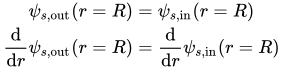
Note that ; because of the small neutron mass and energy (see above), as well as the small size of a nucleus (femtometers). Therefore:

- Failed to parse (Conversion error. Server ("https://wikimedia.org/api/rest_") reported: "Cannot get mml. Server problem."): {\displaystyle {\begin{alignedat}{2}\psi _{s,\mathrm {out} }&={\frac {\sin(kR)}{kR}}-b{\frac {e^{ikR}}{r}}\\&\approx 1-b/r\end{alignedat}}}
and so:
- Failed to parse (Conversion error. Server ("https://wikimedia.org/api/rest_") reported: "Cannot get mml. Server problem."): {\displaystyle {\begin{alignedat}{2}\psi _{s,\mathrm {out} }(r=R)&=\psi _{s,\mathrm {in} }(r=R)\\1-{\frac {b}{R}}&=A{\frac {\sin(qR)}{qR}}\\R-b&=A{\frac {\sin(qR)}{q}}\end{alignedat}}}
And from equating the derivatives:
- Failed to parse (Conversion error. Server ("https://wikimedia.org/api/rest_") reported: "Cannot get mml. Server problem."): {\displaystyle {\begin{alignedat}{2}1&=A\cos(qR)\\A&={\frac {1}{\cos(qR)}}\end{alignedat}}}
Combining the two results yields:
- Failed to parse (Conversion error. Server ("https://wikimedia.org/api/rest_") reported: "Cannot get mml. Server problem."): {\displaystyle {\begin{alignedat}{2}R-b&=\left({\frac {1}{\cos(qR)}}\right){\frac {\sin(qR)}{q}}\\{\frac {R}{R}}-{\frac {b}{R}}&={\frac {\tan(qR)}{q}}{\frac {1}{R}}\\{\frac {b}{R}}&=1-{\frac {\tan(qR)}{qR}}\end{alignedat}}}
This final equation gives a first-order estimate for the scattering length, b, given the radius of the nucleus (R ~ 10−15 m) and the depth of the potential well (V0 ~ MeV).

The extreme variation of b/R as a function of qR means that with each nucleon added, the scattering length jumps to a very different value. This also demonstrates why the scattering length can be negative (indicative of negative phase shift). This model should only be taken qualitatively, of course (e.g. we have neglected absorption, as well as the detailed form of the nuclear potential).

