Difference between revisions of "Scattering"
KevinYager (talk | contribs) |
KevinYager (talk | contribs) |
||
| Line 1: | Line 1: | ||
| + | [[Image:Standard-AgBH-gisaxs th000 spot3 60sec SAXS.png|thumb|300px|right|Example scattering pattern (for [[Material:Silver behenate}AgBH]]).]] | ||
| + | |||
'''Scattering''' broadly refers to experimental techniques that use the interaction between radiation and matter to elucidate structure. In [[x-ray]] scattering, a collimated x-ray beam is directed at a sample of interest. The incident x-rays scatter off of all the atoms/particles in the sample. Because of the wavelike nature of x-rays (which are simply high-energy photons; i.e. electromagnetic rays), the scattered waves interfere with one another, leading to constructive interference at some angles, but destructive interference at other angles. The end result is a pattern of scattered radiation (as a function of angle with respect to the direct beam) that encodes the microscopic, nanoscopic, and molecular-scale structure of the sample. | '''Scattering''' broadly refers to experimental techniques that use the interaction between radiation and matter to elucidate structure. In [[x-ray]] scattering, a collimated x-ray beam is directed at a sample of interest. The incident x-rays scatter off of all the atoms/particles in the sample. Because of the wavelike nature of x-rays (which are simply high-energy photons; i.e. electromagnetic rays), the scattered waves interfere with one another, leading to constructive interference at some angles, but destructive interference at other angles. The end result is a pattern of scattered radiation (as a function of angle with respect to the direct beam) that encodes the microscopic, nanoscopic, and molecular-scale structure of the sample. | ||
Revision as of 09:36, 25 August 2014

Scattering broadly refers to experimental techniques that use the interaction between radiation and matter to elucidate structure. In x-ray scattering, a collimated x-ray beam is directed at a sample of interest. The incident x-rays scatter off of all the atoms/particles in the sample. Because of the wavelike nature of x-rays (which are simply high-energy photons; i.e. electromagnetic rays), the scattered waves interfere with one another, leading to constructive interference at some angles, but destructive interference at other angles. The end result is a pattern of scattered radiation (as a function of angle with respect to the direct beam) that encodes the microscopic, nanoscopic, and molecular-scale structure of the sample.
Geometry
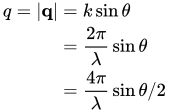
We define a vector in reciprocal-space as the difference between the incident and scattered x-ray beams. This new vector is the momentum transfer, denoted by q:
- Failed to parse (MathML with SVG or PNG fallback (recommended for modern browsers and accessibility tools): Invalid response ("Math extension cannot connect to Restbase.") from server "https://wikimedia.org/api/rest_v1/":): {\displaystyle \begin{alignat}{2} \mathbf{q} & = \mathbf{k}_o - \mathbf{k}_i \\ & = k(\mathbf{s}_o - \mathbf{s}_i) \\ & = \frac{2 \pi}{\lambda}(\mathbf{s}_o - \mathbf{s}_i) \end{alignat} }
The length of this vector is:
Theory
The mathematical form of scattering is closely related to the Fourier transform. The sample's realspace density distribution is Fourier transformed into an abstract 3D reciprocal-space; scattering probes this inverse space.

