Difference between revisions of "Form Factor:Cylindrical symmetry"
KevinYager (talk | contribs) (Created page with "==Derivation== ===Form Factor=== Assuming a particle is cylindrically-symmetric: ::<math>\rho(\mathbf{r}) = \rho(r,\phi,z) = \rho(r)</math> We of course use [http://en.wikiped...") |
KevinYager (talk | contribs) |
||
| Line 21: | Line 21: | ||
F(\mathbf{q}) | F(\mathbf{q}) | ||
& = \int \rho(\mathbf{r}) e^{i \mathbf{q} \cdot \mathbf{r} } \mathrm{d}V \\ | & = \int \rho(\mathbf{r}) e^{i \mathbf{q} \cdot \mathbf{r} } \mathrm{d}V \\ | ||
| − | & = \int\limits_{z=}^{L}\int\limits_{\phi=0}^{2 \pi}\int\limits_{r=0}^{\infty} \rho(r) e^{i \mathbf{q} \cdot \mathbf{r} } r \mathrm{d}r \mathrm{d}\phi \mathrm{d}z \\ | + | & = \int\limits_{z=0}^{L}\int\limits_{\phi=0}^{2 \pi}\int\limits_{r=0}^{\infty} \rho(r) e^{i \mathbf{q} \cdot \mathbf{r} } r \mathrm{d}r \mathrm{d}\phi \mathrm{d}z \\ |
& = \int\limits_{0}^{L}\int\limits_{0}^{2 \pi}\int\limits_{0}^{\infty} \rho(r) e^{i (q_x r \cos \phi + q_z z) } r \mathrm{d}r \mathrm{d}\phi \mathrm{d}z \\ | & = \int\limits_{0}^{L}\int\limits_{0}^{2 \pi}\int\limits_{0}^{\infty} \rho(r) e^{i (q_x r \cos \phi + q_z z) } r \mathrm{d}r \mathrm{d}\phi \mathrm{d}z \\ | ||
& = \left( \int\limits_{0}^{L} e^{i q_z z } \mathrm{d}z \right) \int\limits_{0}^{\infty} r \rho(r) \left ( \int\limits_{0}^{2 \pi} e^{i q_x r \cos \phi } \mathrm{d}\phi \right) \mathrm{d}r \\ | & = \left( \int\limits_{0}^{L} e^{i q_z z } \mathrm{d}z \right) \int\limits_{0}^{\infty} r \rho(r) \left ( \int\limits_{0}^{2 \pi} e^{i q_x r \cos \phi } \mathrm{d}\phi \right) \mathrm{d}r \\ | ||
Latest revision as of 13:17, 23 May 2022
Derivation
Form Factor
Assuming a particle is cylindrically-symmetric:

We of course use cylindrical coordinates:

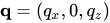
We can take advantage of the cylindrical symmetry by rotating any candidate q-vector into the plane, eliminating the component:


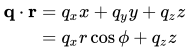
The form factor is (note that the integration limits in z define the particle size in that direction):
![{\displaystyle {\begin{alignedat}{2}F(\mathbf {q} )&=\int \rho (\mathbf {r} )e^{i\mathbf {q} \cdot \mathbf {r} }\mathrm {d} V\\&=\int \limits _{z=0}^{L}\int \limits _{\phi =0}^{2\pi }\int \limits _{r=0}^{\infty }\rho (r)e^{i\mathbf {q} \cdot \mathbf {r} }r\mathrm {d} r\mathrm {d} \phi \mathrm {d} z\\&=\int \limits _{0}^{L}\int \limits _{0}^{2\pi }\int \limits _{0}^{\infty }\rho (r)e^{i(q_{x}r\cos \phi +q_{z}z)}r\mathrm {d} r\mathrm {d} \phi \mathrm {d} z\\&=\left(\int \limits _{0}^{L}e^{iq_{z}z}\mathrm {d} z\right)\int \limits _{0}^{\infty }r\rho (r)\left(\int \limits _{0}^{2\pi }e^{iq_{x}r\cos \phi }\mathrm {d} \phi \right)\mathrm {d} r\\&=\left(\left[{\frac {1}{iq_{z}}}e^{iq_{z}z}\right]_{z=0}^{L}\right)\int \limits _{0}^{\infty }r\rho (r)\left(\int \limits _{0}^{2\pi }e^{iq_{x}r\cos \phi }\mathrm {d} \phi \right)\mathrm {d} r\\&=\left({\frac {e^{iq_{z}L}-1}{iq_{z}}}\right)\int \limits _{0}^{\infty }r\rho (r)\left(\int \limits _{0}^{2\pi }e^{iq_{x}r\cos \phi }\mathrm {d} \phi \right)\mathrm {d} r\\\end{alignedat}}}](https://wikimedia.org/api/rest_v1/media/math/render/svg/640a2f4256ddd9d94d637ca07d688f44b126ece5)

