Difference between revisions of "Debye-Waller factor"
(Created page with "The '''Debye-Waller factor''' is a term (in scattering equations) which accounts for how thermal fluctuations extinguish scattering intensity (especially high-''q'' peaks). Th...") |
|||
| Line 12: | Line 12: | ||
</math> | </math> | ||
Where <math>\sigma_{\mathrm{rms}} \equiv \sqrt{ \langle u^2 \rangle }</math> is the [http://en.wikipedia.org/wiki/Root_mean_square root-mean-square] displacement of the lattice-spacing ''a'' (such that the spacing at time ''t'' is <math>a+u(t)</math>), and <math>\sigma_a \equiv \sigma_{\mathrm{rms}}/a</math> is the relative displacement. | Where <math>\sigma_{\mathrm{rms}} \equiv \sqrt{ \langle u^2 \rangle }</math> is the [http://en.wikipedia.org/wiki/Root_mean_square root-mean-square] displacement of the lattice-spacing ''a'' (such that the spacing at time ''t'' is <math>a+u(t)</math>), and <math>\sigma_a \equiv \sigma_{\mathrm{rms}}/a</math> is the relative displacement. | ||
| + | |||
| + | Thus, the intensity of the structural peaks is multiplied by <math>G(q)</math>, which attenuates the higher-order (high-''q'') peaks, and redistributes this intensity into a diffuse scattering term, which appears in the [[structure factor]] (<math>S(q)</math>) as: | ||
| + | :<math> | ||
| + | S_{\mathrm{diffuse}}(q) = \left[ 1- G(q) \right] | ||
| + | </math> | ||
| + | And thus appears in the overall intensity as: | ||
| + | :<math> | ||
| + | I_{\mathrm{diffuse}}(q) = P(q) \left[ 1- G(q) \right] | ||
| + | </math> | ||
| + | where <math>P(q)</math> is the [[form factor]]. | ||
==See Also== | ==See Also== | ||
* [http://en.wikipedia.org/wiki/Debye%E2%80%93Waller_factor Wikipedia: Debye-Waller factor] | * [http://en.wikipedia.org/wiki/Debye%E2%80%93Waller_factor Wikipedia: Debye-Waller factor] | ||
Revision as of 21:38, 3 June 2014
The Debye-Waller factor is a term (in scattering equations) which accounts for how thermal fluctuations extinguish scattering intensity (especially high-q peaks). This scattering intensity then appears as diffuse scattering. Conceptually, thermal fluctuations create disorder, because the atoms/particles oscillate about their equilibrium positions and thus the lattice is never (instantaneously) perfect.
Mathematical form
For a lattice-size a, the constituent entities (atoms, particles, etc.) will oscillate about their equilibrium positions with an rms width , attenuating structural peaks like:

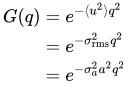
Where is the root-mean-square displacement of the lattice-spacing a (such that the spacing at time t is ), and is the relative displacement.
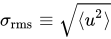


Thus, the intensity of the structural peaks is multiplied by , which attenuates the higher-order (high-q) peaks, and redistributes this intensity into a diffuse scattering term, which appears in the structure factor () as:


![{\displaystyle S_{\mathrm {diffuse} }(q)=\left[1-G(q)\right]}](https://wikimedia.org/api/rest_v1/media/math/render/svg/270d7fa5d0305ce1eca18d6189773bb6901de06e)
And thus appears in the overall intensity as:
![{\displaystyle I_{\mathrm {diffuse} }(q)=P(q)\left[1-G(q)\right]}](https://wikimedia.org/api/rest_v1/media/math/render/svg/cc54776d6841468b7ee4f513b0efa51af03f849b)
where is the form factor.


